

Configure blind transfer modes
Blind transfer sends the active call to a destination without speaking to the destination first. Use it when the destination can accept the call immediately and does not need a spoken introduction.
This guide starts with an existing transfer call tool. To create the tool, configure destinations, and add it to an assistant, follow Transfer Call tool.
Choose a blind transfer mode
Both blind modes transfer the caller immediately. The summary variant adds context for a Session Initiation Protocol (SIP) system without speaking that context aloud.
Blind transfer is the default. If transferPlan is omitted, Vapi uses blind-transfer.
Configure blind transfer
Update the transfer plan on each destination that should use blind transfer.
Dashboard
curl
Open the transfer destination
In the Vapi Dashboard, open Tools, select the transfer call tool, and expand Destinations. Select the phone-number or SIP destination you want to configure.
Select the transfer mode
Expand Transfer Plan. Under Transfer Mode, select Blind Transfer or Blind Transfer with Summary in SIP Header.
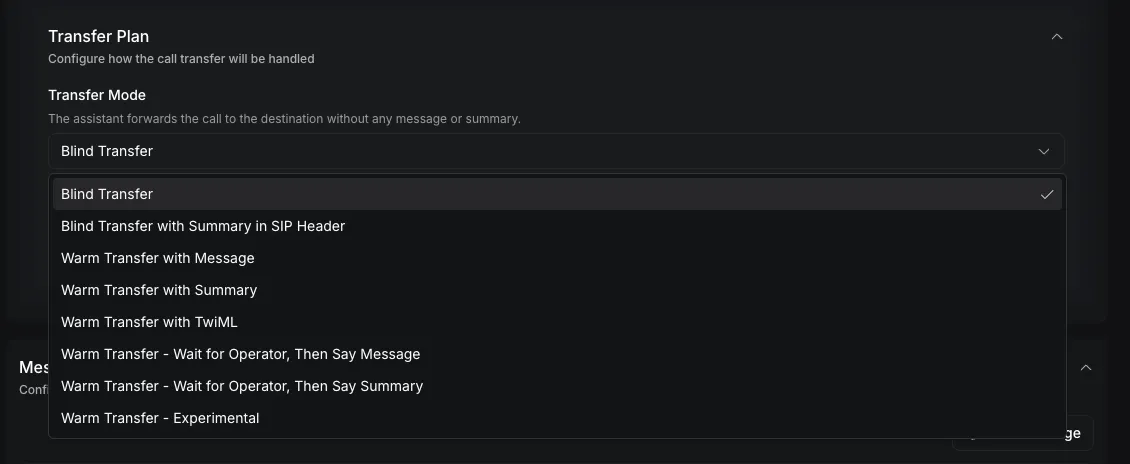
Choose the SIP behavior for a summary transfer
Complete this step only if you selected Blind Transfer with Summary in SIP Header. Under SIP Verb, select the behavior required by your SIP infrastructure:
- REFER — hand the call to the destination (default) sends a SIP REFER.
- Dial — bridge a new outbound leg to the destination keeps Vapi in the call path while dialing.
- Bye — hang up the Vapi leg only; no transfer is placed and the destination is not dialed is for SIP systems that complete the transfer independently.
If you select Dial, set Dial Timeout (seconds) from 1 to 600 seconds. The default is 60 seconds.
Choose a SIP verb
The SIP verb affects only calls running on SIP telephony. Other telephony providers ignore this setting.
Do not use bye when you expect Vapi to dial the destination. It intentionally places no destination call.
Verify the transfer
Place a test call and trigger the transfer. Confirm that the destination rings and that the customer and destination can hear each other.
For blind-transfer-add-summary-to-sip-header, inspect the SIP signaling at the receiving private branch exchange (PBX) or provider. Confirm that the destination INVITE or REFER flow contains X-Transfer-Summary and that the value contains the expected summary.
An assistant-forwarded-call ended reason confirms that Vapi initiated the transfer. It does not confirm that the downstream PBX or provider completed it.
Troubleshooting
For additional provider diagnostics and packet capture guidance, follow Troubleshoot call forwarding drops.
API reference
The Update Tool API reference documents the transfer destination and transfer-plan fields accepted when updating a reusable tool.