

Configure warm transfer modes
Traditional warm transfer dials the destination, delivers context on the destination call leg, and then connects the customer. Use these modes when the destination needs a fixed message, generated summary, or Twilio Markup Language (TwiML) instructions before receiving the call.
This guide starts with an existing transfer call tool. To create the tool, configure destinations, and add it to an assistant, follow Transfer Call tool. For an AI conversation with the destination, use Assistant-based warm transfer.
These five warm-transfer modes are supported on Twilio calls. Vapi uses Twilio while dialing and controlling the separate call to the receiving person, called the destination leg. Test the transfer through the same Twilio phone number and destination you will use in production.
Choose a warm transfer mode
Choose the mode based on what the destination should hear and whether Vapi should wait for the destination to speak.
The wait-first modes are useful when the destination has an automated greeting or when you want to avoid speaking over the operator. Their timeout controls how long Vapi waits before delivering the message or summary.
For more information about Warm Transfer - Experimental, including how to configure an AI assistant to speak with the destination before connecting the customer, see Assistant-based warm transfer.
Configure warm transfer
Update the transfer plan on each destination that should use a traditional warm transfer.
Dashboard
curl
Open the transfer destination
In the Vapi Dashboard, open Tools, select the transfer call tool, and expand Destinations. Select the phone-number destination you want to configure.
Select the transfer mode
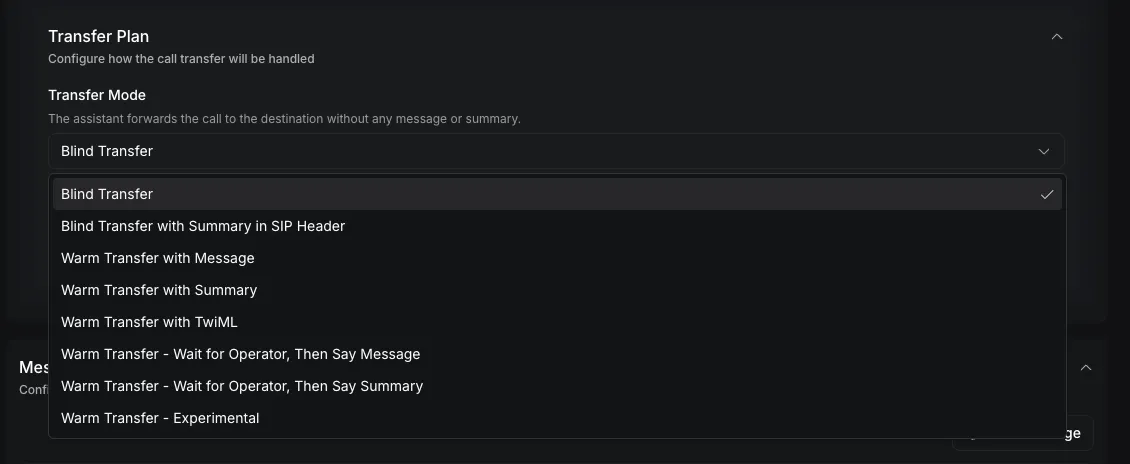
Expand Transfer Plan. Under Transfer Mode, select one of the five warm-transfer modes covered by this guide.
Configure the destination content
For a message mode, enter the fixed introduction under Message to Operator.
For a summary mode, use Summary Plan to enable summary generation. Configure the system message, the user message containing {{transcript}}, and a summary timeout from 1 to 60 seconds.
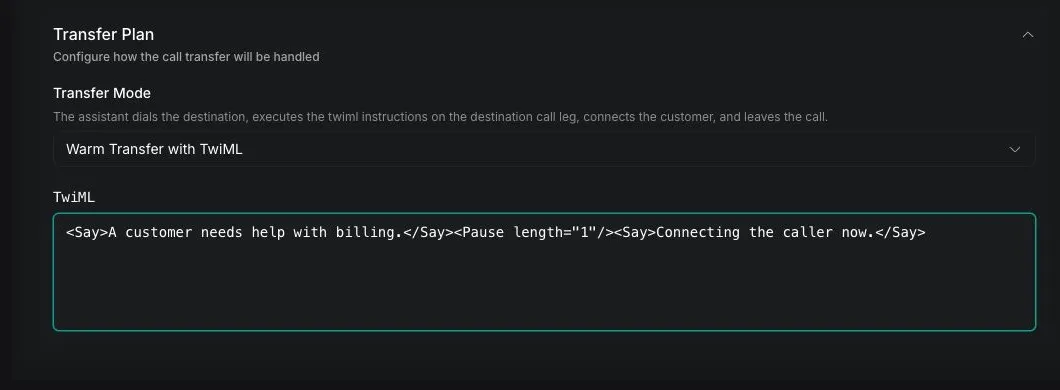
For the TwiML mode, enter valid TwiML in TwiML.
Configure messages and summaries
A message mode speaks the exact value of transferPlan.message. Use it when every call to the destination can use the same introduction.
A summary mode generates destination-specific context with transferPlan.summaryPlan. The user message must include {{transcript}} if the summary should use the conversation. This is separate from the assistant’s end-of-call analysis summary, which runs after the call and is not spoken during transfer.
Keep destination introductions short. The destination is waiting to receive a live caller, so include only the caller’s intent and the information needed to accept the call. A message value can be at most 1,000 characters.
Configure TwiML
Use warm-transfer-twiml when the destination call leg needs instructions beyond a single message. See Twilio’s TwiML for Programmable Voice reference for the XML format and general behavior. The twiml value can contain at most 4,096 characters and supports these verbs in a Vapi transfer:
SayPlayGatherPauseHangup
The TwiML runs on the destination call leg before the customer is connected. Test menus and Gather behavior with the exact destination system used in production.
Verify the warm transfer
Place a test call and trigger the configured destination. Confirm that:
- The destination rings before the customer is connected.
- The destination hears the configured message, generated summary, or TwiML output.
- A wait-first mode allows the operator to speak before delivering the content.
- The customer and destination can hear each other after the introduction.
In Logs → Calls, inspect the transfer history and destination content. Check the Logs tab for validation, summary-generation, and transfer errors.
Troubleshooting
If the transfer is initiated but the destination never rings or the call drops, follow Troubleshoot call forwarding drops.
API reference
The Update Tool API reference documents transfer-plan messages, summary plans, timeouts, and TwiML fields.